Slewing bearings are divided into three categories by gear ring structure: internal gear type, external gear type and gearless type. The gear type selection directly determines the transmission layout, load capacity, maintenance difficulty and full-life cycle cost of the whole machine. Many purchasers only focus on tonnage and installation dimensions during selection, ignoring the adaptability between gear type and working conditions, which eventually leads to low transmission efficiency, rapid tooth surface wear and premature seal failure. This article makes a horizontal comparison from three dimensions: structure & transmission, load performance and cost & maintenance, provides a decision guide combined with typical application scenarios, and sorts out common selection pitfalls to help quickly match the optimal solution.
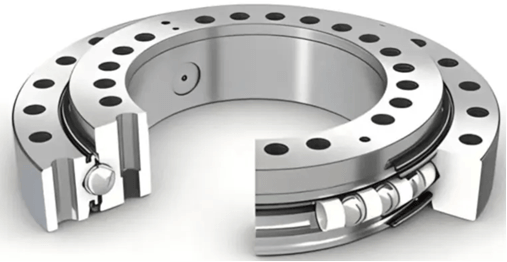
Three-Dimensional Comparison Table of Three Slewing Bearing Types
|
Comparison Dimension |
Internal Gear Type |
External Gear Type |
Gearless Type |
|
Transmission & Structural Features |
Gear ring is inside the bearing with built-in slewing motor, compact structure and small external footprint; gear ring is protected by housing, not directly impacted by dust and gravel |
Gear ring is outside the bearing with external motor, flexible layout and easy assembly & maintenance; tooth surface is exposed and vulnerable to environmental erosion |
No gear ring structure, driven by external force or manual rotation; simplest structure with smallest radial size |
|
Load & Working Condition Performance |
Higher tooth root strength at the same outer diameter, bears larger overturning moment and impact load, suitable for heavy-duty and high-impact conditions; stable transmission and good accuracy retention |
Better heat dissipation at the same module, convenient gear lubrication and maintenance; slightly lower load capacity than internal gear type of the same specification, suitable for medium-light load and conventional operations |
Only bears axial, radial and overturning loads, no transmission load requirement; low rotation speed, customizable positioning accuracy, suitable for scenarios without continuous rotary drive |
|
Cost & Maintenance Attributes |
Complex processing technology and high manufacturing cost; built-in gear ring has long lubrication cycle, low daily maintenance frequency and less sealing investment |
Low processing difficulty and lower procurement cost; exposed tooth surface requires regular grease replenishment, fast wear under harsh conditions and high long-term maintenance cost |
Fewest processing procedures and lowest procurement cost; no gear wear, only regular raceway lubrication maintenance, with the lowest full-life cycle maintenance cost |
2. Application Scenario Decision Guide
1. Heavy-duty & High-impact Scenarios: Prioritize Internal Gear Type
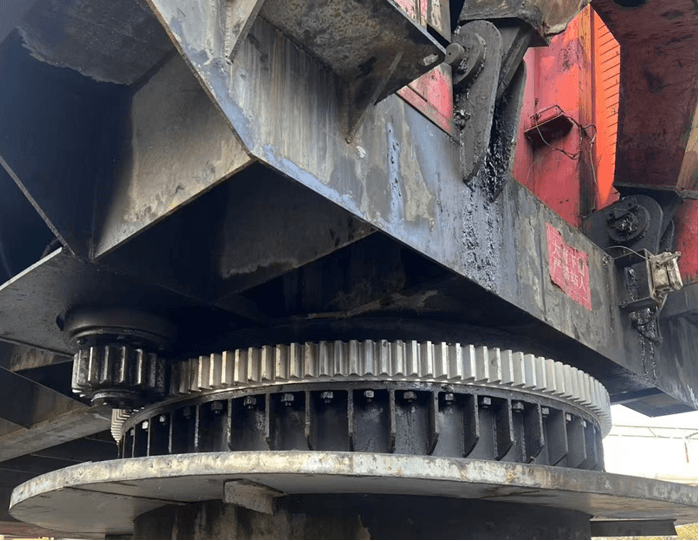
For equipment such as large mining excavators, heavy tower cranes and portal cranes, with heavy load, high impact and requirements for compact layout, internal gear type is the optimal choice. The built-in gear ring avoids direct impact of gravel and mine dust on the tooth surface. With large-module gear ring and reinforced raceway design, it can bear strong overturning moment and has higher reliability in long-term continuous operation.
2. Medium-light Duty Construction Machinery: Prioritize External Gear Type
For general construction equipment such as small and medium excavators, truck-mounted cranes and aerial work platforms with relatively mild working conditions, external gear type has lower procurement cost. The external motor design makes assembly, disassembly, maintenance and gear grease replenishment more convenient, with the highest comprehensive cost performance. It is also the most widely used gear type in construction machinery at present.
3. Low-speed Scenarios Without Continuous Drive: Prioritize Gearless Type
For scenarios such as welding positioners, medical CT turntables and automatic rotary worktables, there is no need for continuous gear drive, and most adopt hydraulic drive, friction drive or manual rotation. The gearless structure can minimize the radial installation size, with stable positioning accuracy and no gear wear failure, delivering the lowest full-life cycle maintenance cost.
4. Common Selection Pitfall Reminders
First, blindly following the original gear type without adapting to working conditions. Many equipment modifications and parts replacements directly copy the original gear type, ignoring actual working condition changes. For example, for small and medium excavators equipped with hydraulic breakers, the original external gear bearing can no longer adapt to high impact load, and should be upgraded to an internal gear solution of the same specification; otherwise, the tooth surface service life will be shortened by more than 60%.
Second, assuming internal gear type always has higher load capacity and ignoring basic structural parameters. The core of load capacity lies in raceway structure, module size and heat treatment process, not just the gear type. The impact resistance of small-module internal gear type is often weaker than that of large-module external gear products. Selection cannot only depend on gear type, but requires comprehensive judgment combined with raceway form, module and quenching depth.
Third, assuming gearless type has no technical threshold and arbitrarily lowering selection standards. Although gearless type has no gear transmission requirement, it still has strict standards for raceway machining accuracy, sealing structure and load matching. Wrong gearless selection in heavy-duty low-speed scenarios can easily cause raceway crushing, slewing jamming and other serious equipment failures.
Overall, the three gear types have no absolute advantages or disadvantages, only suitability differences. Comprehensive judgment based on transmission layout, working load and maintenance cost will help select the slewing bearing solution that best fits actual needs.