As the core load-bearing component of the excavator slewing mechanism, the slewing bearing bears the full load and overturning moment of the upper body. Its selection must be precisely matched to the machine’s tonnage and operating conditions. Different tonnages correspond to huge differences in bearing structure, load rating, tooth surface strength and raceway thickness. Blind cross-tonnage selection will accelerate wear in mild cases, and cause safety failures such as gear ring fracture and slewing jamming in severe cases. This article breaks down selection solutions for four tonnage levels: 1-15 ton mini excavators, 15-30 ton medium excavators, 30-50 ton large excavators, and above 50 ton mining excavators. It also explains core selection methods and impact allowance design principles, forming a practical quick-reference logic.
1. Selection Solutions for Four Tonnage Levels
1-15 Ton Mini Excavators
Mini excavators are mostly used in municipal landscaping, indoor demolition, farmland reconstruction and rural infrastructure projects, with narrow working space, frequent slewing start-stops, light overall load and controllable impact.
For selection, single-row four-point contact ball slewing bearings are preferred, mainly standard external gear structure, with module usually in the range of 6-10mm and flange thickness of 25-40mm. A raceway quenching depth of ≥1.5mm can meet daily working conditions, and there is no need to excessively pursue heavy-duty thickened designs to avoid unnecessary cost waste. Note that mini excavators have very limited installation space. When selecting, the installation spigot height and bolt hole positions must be strictly verified. Lightweight products are preferred to reduce slewing motor load and improve overall fuel economy.
Medium excavators are the main force in earthwork and urban infrastructure, covering ordinary earth excavation, light crushing, river dredging, etc. With a wide load fluctuation range, they belong to general heavy-duty scenarios and account for the largest market share.
For selection, single-row crossed roller or reinforced four-point contact ball structures are recommended, available in both internal and external gear types, with module range 10-14mm and flange thickness 40-60mm. The raceway quenching depth shall be ≥2mm, and the tooth surface hardness shall reach HRC58-62. Basic impact allowance must be reserved to adapt to the intermittent impact load brought by attachments such as hydraulic breakers. There are many brands in this tonnage range with large differences in original parameters. When selecting, original installation dimensions must be verified simultaneously, and direct-replacement products with fully matching parameters are preferred to avoid on-site modification.
Large excavators are mostly used in mine surface stripping, large-scale earthwork and heavy crushing operations. The equipment operates continuously under heavy load with strong impact, requiring extremely high fatigue resistance and structural strength of bearings.
Standard selection includes double-row different-diameter ball or three-row roller slewing bearings, mainly internal gear structure, with module range 14-18mm and flange thickness 60-90mm. The raceway adopts integral quenching process with quenching depth ≥2.5mm, and the tooth root is strengthened by shot peening to greatly improve bending fatigue resistance. Special attention: large excavator bearings can weigh hundreds of kilograms. During assembly, high-strength bolts of grade 10.9 and above must be used, and tightened diagonally in stages strictly according to original torque specifications to prevent bearing offset and eccentric wear caused by loose bolts.
Mining excavators operate year-round in extreme conditions such as open-pit mines and large quarries, mostly working 24 hours continuously, bearing huge overturning moments and strong impact loads. This is the application scenario with the highest slewing bearing wear rate.
Three-row roller heavy-duty slewing bearings must be selected, with internal gear large-module design, module range 18-25mm and flange thickness above 90mm. Both raceway and tooth surface adopt deep quenching process with quenching depth of 3-4mm. Meanwhile, multi-channel labyrinth sealing structure is equipped to resist mine dust and muddy water intrusion and extend lubrication cycle. Sufficient impact allowance must be reserved for mining bearings: the rated static load shall exceed the actual working load by more than 30%. It is strictly forbidden to use ordinary large excavator bearings as downgraded substitutes, otherwise malignant accidents such as raceway crushing and gear ring fracture are very likely to occur.
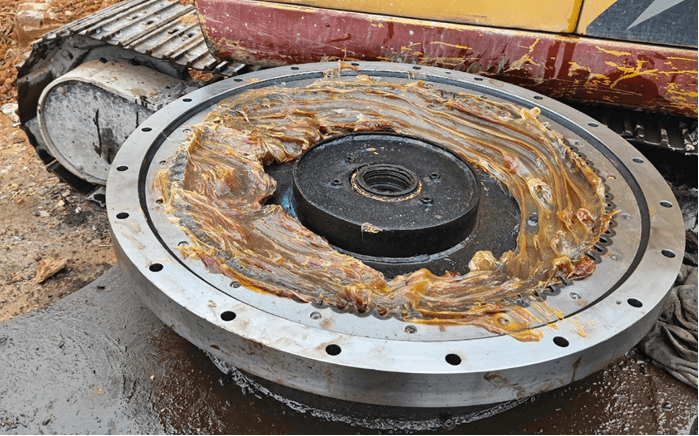
Slewing bearing selection cannot take machine tonnage as the only basis, but must follow the core principle of "working condition first, allowance as guarantee". First, match the corresponding tonnage range according to the machine’s own weight; second, adjust the grade according to the actual operating scenario: for equipment equipped with impact tools such as hydraulic breakers and shears, it is recommended to upgrade the selection standard by one level.
The core verification parameters include rated static load, rated dynamic load and overturning moment capacity, all of which must cover the maximum operating load of the machine. Among them, impact allowance is the most easily overlooked safety redundancy: 15%-20% is recommended for ordinary earthwork, 25%-30% for crushing operations, and ≥30% for continuous heavy-duty mining operations. Insufficient allowance will greatly shorten the service life, while excessive allowance will increase unnecessary procurement and operation costs.
3. Quick Selection Summary
|
Tonnage Range |
Recommended Bearing Structure |
Module Range |
Typical Applications |
Recommended Impact Allowance |
|
1-15 Ton Mini Excavator |
Single-row four-point contact ball type |
6-10mm |
Municipal works, landscaping, light-duty operations |
10%-15% |
|
15-30 Ton Medium Excavator |
Crossed roller / reinforced ball type |
10-14mm |
Earthwork, infrastructure, light crushing |
20%-25% |
|
30-50 Ton Large Excavator |
Double-row ball / three-row roller type |
14-18mm |
Heavy earthwork, medium & large crushing |
25%-30% |
|
Above 50 Ton Mining Excavator |
Three-row roller heavy-duty structure |
18-25mm |
Mining extraction, continuous heavy duty |
≥30% |
Tonnage grading is the basic logic for slewing bearing procurement and selection. Adjusting impact allowance according to operating conditions ensures bearing durability and reliability while controlling costs. After matching basic parameters with the quick reference table, further verify installation dimensions, tooth profile specifications and bolt standards to quickly complete accurate selection and effectively reduce trial-and-error costs and equipment downtime risks.