The raceways and tooth surfaces of slewing bearings operate under long-term heavy-load alternating friction. Standardized lubrication directly determines the wear rate and overall service life of components. Wrong grease grade, unreasonable filling intervals and improper greasing operations will cause premature raceway wear, tooth surface pitting and seal failure, and even lead to severe failures such as slewing jamming and gear root fracture in serious cases. This article covers three core dimensions: NLGI consistency grade selection, greasing frequency for different working conditions, and standard greasing operation methods, together with 5 common mistakes, to help you build a standardized lubrication maintenance system.
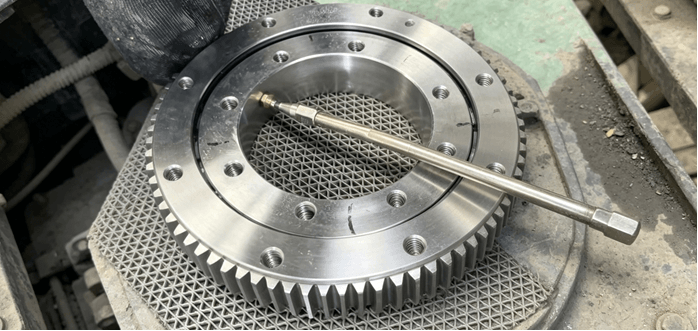
1. NLGI Grade Selection Guide for Grease
NLGI is a grease consistency grading standard developed by the National Lubricating Grease Institute. The higher the grade number, the harder the grease. Slewing bearings shall select the corresponding consistency grade according to ambient temperature, operating speed and load intensity, and match the appropriate base oil type.
Recommended Base Oil Type
- Synthetic hydrocarbon base oil
- Lithium-based grease
- Extreme pressure lithium grease
- Polyurea / complex lithium grease
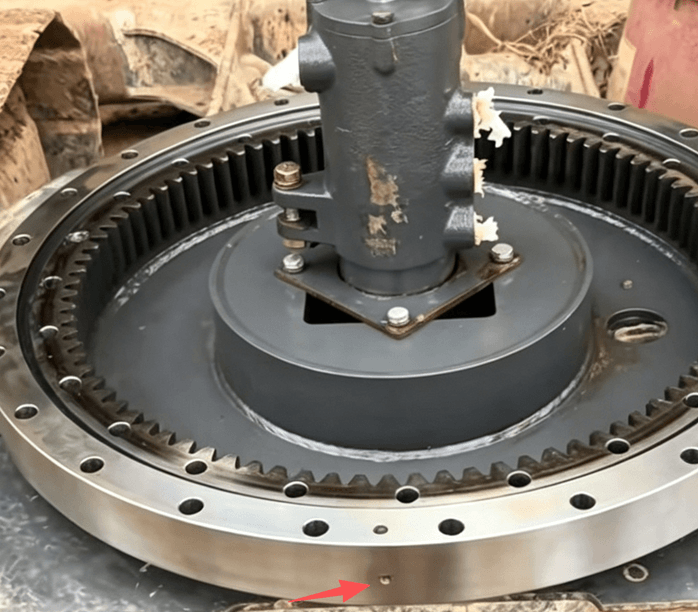
2. Greasing Frequency Reference for Different Working Conditions
The filling interval is not fixed; it shall be dynamically adjusted according to operation intensity and environmental harshness. The following are recommended intervals for typical working conditions, based on raceway lubrication. Tooth surface lubrication interval is about half of the raceway interval.
Normal earthwork (normal temperature & low dust): Raceway greasing every 250 working hours, tooth surface coating every 120-150 hours — basic maintenance cycle.
Crushing heavy duty: High impact load and strong vibration. Raceway greasing every 100-150 hours, tooth surface replenishment every 80 hours to avoid oil film rupture and dry friction.
Heavy dust mining: Dust easily intrudes and dilutes grease. Raceway greasing every 100 hours to discharge old grease and dust each time; tooth surface replenishment after cleaning every 50-80 hours.
Submerged / high humidity: Adopt waterproof grease. Raceway greasing every 200 hours, focus on checking seal water ingress to prevent grease emulsification failure.
Extreme cold / high temperature special conditions: Match special grease. Raceway greasing every 150 hours, replace corresponding consistency grade when seasons change.
3. Standard Greasing Operation Methods
Pre-greasing cleaning: Thoroughly clean dust and sediment on grease nipple surfaces before filling to avoid impurities entering the raceway with grease and causing abrasive wear.
Slow and uniform filling: Use a grease gun to apply pressure slowly at multiple points, fill sequentially along circumferential grease nipples until new grease overflows evenly from the sealing ring, which indicates sufficient filling.
Rotate while greasing: Slowly rotate the slewing bearing during filling to distribute grease evenly in the raceway, avoiding local oil shortage or local excess.
Independent tooth surface lubrication: Tooth surface meshing wear rate is higher than raceway. Apply grease separately by coating method, evenly covering the meshing working surface. Do not apply excessive grease to avoid splashing waste.
Thorough cleaning for grease replacement: When replacing grease of different grades, thoroughly clean old grease residues. Mixing old and new greases of different base oils is strictly prohibited to prevent lubrication failure from chemical reaction.
4. Five Common Lubrication Mistakes
Myth 1: More grease is better. Excessive filling causes increased internal running resistance, poor heat dissipation and seal swelling leakage. Best filling volume is when new grease slightly overflows from the sealing ring.
Myth 2: Greases of different grades can be mixed freely. Different base oils and additive systems will chemically react, destroy oil film structure and directly cause lubrication failure. Old grease must be cleaned before replacement.
Myth 3: Only focus on brand, ignore NLGI grade. Different consistency grades of the same brand apply to completely different scenarios. Using Grade 00 in summer or Grade 2 in winter will cause lubrication failures.
Myth 4: Only grease raceways, ignore tooth surfaces. Tooth surfaces undergo combined sliding + rolling friction with faster wear, and cannot be effectively lubricated by raceway overflow grease. Separate regular replenishment is mandatory.
Myth 5: Only replenish grease when abnormal noise occurs. When slewing noise or jamming appears, the raceway has already suffered dry friction damage. Grease replenishment at this stage can only delay deterioration but cannot reverse wear. Preventive regular filling is the core of extending service life.
Overall, lubrication is the maintenance method with the lowest cost and highest return for slewing bearings. Selecting the right NLGI consistency grade, formulating filling intervals according to working conditions and standardizing greasing operations can extend the service life of slewing bearings by more than 30% and greatly reduce equipment downtime and maintenance costs.
About BRISK: 13 years OEM-compatible slewing bearings & construction machinery parts. Visit https://www.briskslewing.com | Contact: [email protected]