High-strength bolts provide rigid connection between slewing bearings and upper/lower structures. Proper bolt torque and uniform fastening directly determine the bearing's operational stability and overall service life. Insufficient torque causes bolt loosening, bearing displacement and eccentric wear, leading to unilateral tooth surface wear and slewing abnormal noise; excessive torque results in bolt yield fracture and flange cracking, even severe accidents of bearing falling off. This article compiles standard torque values for full-size high-strength bolts from M12 to M30, and clarifies key re-inspection nodes at 24h, 100h, 500h after installation and quarterly routine checks, providing a standardized reference for on-site assembly and daily maintenance.
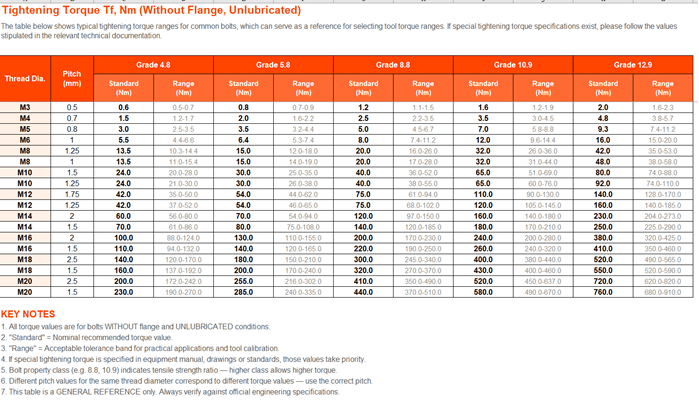
1. Standard Torque Value Comparison Table for M12-M30 Bolts
Slewing bearing fastening bolts are made of high-strength alloy steel, with common property classes of Grade 8.8, Grade 10.9 and Grade 12.9. Different grades correspond to significantly different yield strength and rated torque. The following recommended torque values apply under normal temperature and dry conditions, suitable for conventional scenarios with threads evenly coated with anti-seize lubricant.
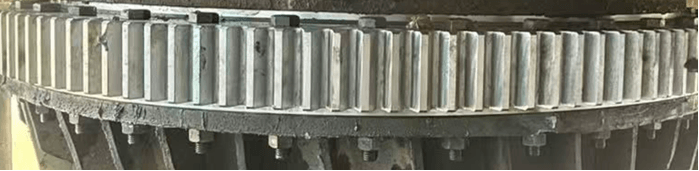
Typical applications by bolt size:
- Mini excavators below 6t, small rotary tables
- 6-15t mini excavators, light truck-mounted cranes
- 15-30t medium excavators, general construction machinery
- 30-50t large excavators, heavy tower cranes
- 50t mining excavators, port lifting equipment
- Super-large mining excavators above 50t
2. Key Nodes of Bolt Re-inspection Cycle
After fastening, bolts will experience stress relaxation under continuous vibration, load impact and temperature changes, with torque gradually attenuating over operation time. Periodic re-inspection and re-tightening are mandatory, with four core nodes that cannot be omitted:
1. First Re-inspection 24 Hours After Installation
After the newly installed bearing is fastened and tested under no-load, the first full-circumference bolt torque re-inspection must be completed within 24 hours. At this stage, initial bolt stress is fully released and flange fitting settlement is finished; about 10%-15% of bolts will show obvious torque attenuation. They need to be re-tightened diagonally in stages according to the standard value, which is the most critical step to prevent early loosening.
2. Second Re-inspection After 100 Working Hours
When the equipment enters the initial load operation stage, the bearing bears alternating load and slewing impact, and bolts enter a period of rapid stress fluctuation. After 100 working hours, fully re-inspect torque of all bolts, focus on bolt status on the main load-bearing side, and re-tighten attenuated bolts in time to avoid expanding loosening causing raceway eccentric wear and gear ring misalignment.
3. In-depth Re-inspection After 500 Working Hours
After 500 working hours, the bearing enters a stable wear stage and bolt stress is basically fully released. In addition to torque re-measurement, this inspection shall also check for bolt corrosion, shank deformation and matching washer crushing damage. For bolts with torque attenuation over 20%, investigate flange flatness issues simultaneously instead of simply re-tightening.
4. Quarterly Regular Routine Re-inspection
After the equipment enters stable operation, conduct bolt torque sampling inspection at least once a quarter. For heavy-duty high-impact conditions such as mining and crushing, the interval shall be shortened to once a month. Routine re-inspection can timely detect hidden dangers of bolt fatigue and loosening, avoid malignant failures such as bolt fracture and bearing displacement, and extend the overall service life of the bearing.
3. Key Precautions for Torque Operation & Re-inspection
- Regularly calibrated torque wrenches must be used. Pneumatic wrenches or ordinary wrenches operated by experience are forbidden, and final torque error shall be controlled within ±5%.
- All bolts must follow the diagonal and staged tightening principle. Circumferential sequential locking is strictly prohibited to avoid flange stress concentration and uneven bearing load.
- Ordinary bolts are forbidden to replace high-strength bolts. The minimum requirement for slewing bearing connecting bolts is Grade 8.8, and Grade 10.9 or above must be used for heavy-duty mining scenarios.
- For special working conditions such as high temperature, submerged and corrosive environments, appropriately reduce torque standards and shorten re-inspection cycles according to environmental conditions to avoid bolt creep or corrosion failure.
Bolt fastening is the most easily overlooked yet highly impactful link in slewing bearing installation and maintenance. Standardized operation according to standard torque values and strict compliance with re-inspection cycles of 24h, 100h, 500h and quarterly can effectively reduce the failure rate of bolt loosening, increase the average service life of slewing bearings by more than 25%, and greatly reduce equipment downtime and maintenance costs.
About BRISK: 13 years OEM-compatible slewing bearings & construction machinery parts. Visit https://www.briskslewing.com | Contact: [email protected]